Book of Talus
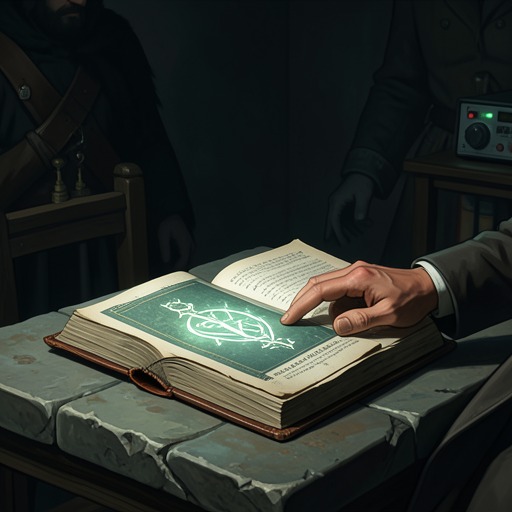
His Property (A Dark Vampire High School Bully Romance) (Vampire Boy Swords): Prince of Londinium (Dead Sun: Prince of Londinium (A Dark High School Bully Romance) (Vampire Boy Swords) Book 1)The Book of Talus is a magical book at the center of Taleian kinship, courtship, and succession. At a child’s birth, it reveals the child’s name and the name of a designated fated mate beside it. Because the book’s decisions govern who may be joined, it converts private desire into an inherited social and political order. Its authority also helps explain why Clara Driscoll becomes the focus of competing claims by Byron Phraeon, Darius Constantine, and Prince Octavius after the revelation of her hidden Taleian lineage.
Origin and Operation
The Book of Talus belongs to the ancient Taleian system described as originating in ancient Britain before the Roman invasion. The Taleians were divided into clans and ruled by Morrigan, Queen of the first Royal Clan, whose consort and Knight of Swords was traditionally taken from the Breannin Clan, the second royal clan. The book operated within this royal structure as more than a record of ancestry: it assigned the mate who would stand beside a child in the Taleian order.
Its mechanism is explicitly mysterious. The name of a child appeared in the book at birth, with the name of that child’s designated fated mate written alongside it, but no one knew how the book produced or received this information. That unexplained process gives the object an authority that is simultaneously archival and supernatural. It preserves a lineage while also presenting its choices as beyond ordinary human verification.
From Fate to Bonding Ritual
The book’s mate-selection rule did not function alone. Taleians were also governed by an ancient mating ritual, still recognizable in the twenty-sixth century even though the Emperor had ordered it weakened or muted. The ritual transformed the book’s designation into a contested bodily and psychic relationship. A prospective mate had to fight several designated challengers before the pair could be joined by blood.
The complete requirement was six sword duels. The mate had to win every duel to keep the designated partner, after which the bond could be consummated through a bite. The sequence made violence a condition of legitimacy: the chosen mate was not simply accepted but defended against challengers. Once established, the psychic bond allowed the partners’ thoughts to flow as one. The bite therefore served as both an intimate union and a physical mark of a victory secured through the ritual.
The surviving court practice is described as a diminished version of the older custom. Because the Emperor suppressed reminders of the earlier Taleian heritage, those who still felt the pull of the old ways sought muted methods of claiming a mate. This produces a conflict between imperial regulation and traditional authority. The Book of Talus remains the source of the mate designation, while the court attempts to control how that designation can be enacted.
Political and Historical Authority
The book was associated with the lost Empress’s government and with the Five Princes who served as her mates and advisers. According to the history Prince Octavius gives Clara Driscoll, the Empress possessed the DNA strands of all the people and ruled wisely with the Five Princes, whose mateship and counsel helped guard her power and keep her safe. The Book of Talus provided these mates and advisers, making it part of the structure that connected reproduction, governance, protection, and royal legitimacy.
That order was destroyed through imperial violence. The Druids’ curse had transformed the Taleians into Vampires, driven them into blood lust, and scattered their clans after persecution by Druids and other humans. The Taleian Queen and the Knight of Swords were murdered while attempting to save their people with the aid of the Magician. Much later, the Emperor found a way to murder the Empress, her child, and the Princes. In this account, suppression of the book’s tradition is not merely cultural modernization; it is part of an effort to erase the political memory of the Empress’s rule.
The book’s authority also belongs to a society altered by biological crisis. Taleians could no longer reproduce among themselves, and Taleian men formed relationships with human women, producing Taleian-human hybrids. These children did not assume their true Taleian vampire form until later in life or until their bodies judged the transformation suitable; they experienced a small death before awakening and thereafter appeared no older than twenty-five. The book’s older system thus persists alongside hybridization, delayed transformation, and a contested definition of who properly belongs to the Taleian line.
Clara Driscoll and Competing Claims
The book’s rules become urgent when Clara Driscoll learns that her apparent twentieth-century identity is false and that she may be the child of the lost Empress, hidden in 1987 centuries before Londinium existed. The discovery turns the book from distant history into a force bearing directly on her body, ancestry, and political significance. Her shock at realizing that her memories and family history were false is inseparable from the larger question of whether her place can be determined by inherited Taleian law.
Byron Phraeon invokes the rule of courtship after a muted public gesture, claiming that he has staked his claim to Clara. Darius Constantine rejects that interpretation, explaining that the ancient Taleian bonding ritual has not been initiated merely because Phraeon has used a restrained form of courtship. Clara objects to being discussed as though she were an object to be owned, exposing the gap between the book’s supposedly sacred order and her own consent.
Prince Octavius presents the traditional system more aggressively. He explains that the ritual requires duels and a blood union, then declares that he would fight to the death to win Clara and rule her. He also says that he felt drawn toward her from the moment he saw her and that his consciousness has reached the edge of her mind, where he expects to establish the bond. His claim treats the book’s mate-selection principle as justification for possession, while Clara experiences the same system as knowledge arriving before she is ready to accept it.
The competing claims also reveal that the old order may no longer produce only one exclusive mate. Darius states that his bond with Clara came first and is currently the strongest, but that she may have more than one mate. Through the bond, he can hear, feel, and see her thoughts, and he warns that Octavius intends to take her through a bite. The possibility of multiple mates complicates the book’s image of a single designated pairing and turns its authority into a field of rivalry rather than a simple answer.
Narrative Significance
As an object, the Book of Talus joins written record, prophecy, bloodline, and bodily transformation. It is never explained as an ordinary book whose contents can be checked; its unexplained birth inscriptions make it an instrument of fate whose authority comes from mystery. Yet the narrative shows that its meaning is mediated by competing voices: Prince Octavius recounts its history, Byron Phraeon invokes courtship law, Darius interprets the bond, and Clara challenges the language of ownership.
The book therefore exposes the instability beneath the Taleian social order. It promises certainty about who belongs with whom, but that certainty generates duels, psychic intrusion, biting, political conflict, and disputes over consent. Its mate-selection rule once helped organize the Empress’s court and protect a royal regime; after the Empress’s murder and the Emperor’s suppression of the old ways, the same rule survives in fragments, stripped of a stable political center. For Clara Driscoll, the Book of Talus is consequently both a key to her lost identity and a mechanism through which others attempt to define, claim, and control her future.